The Red Door
K. E. Karl
“You can’t go in there,” the uniformed man said as I yanked at the door handle.
“But we were in there at the bar just last week,” I replied.
“There’s no bar here,” he responded. “There’s never been a drinking establishment at this address.”
“I don’t understand…” I said.
“Frank, come away,” Jane said. “It’s OK. We’ll get a drink somewhere else.”
“But this is the place we always go for a drink after the movies,” I said.
“It must be somewhere else,” Jane said.
The doorman tilted his head and examined us quizzically but said nothing. We retreated out onto the sidewalk through the revolving glass doors, which I thought was the entrance to our favorite post-film watering hole.
It was a cool, agreeable Philadelphia afternoon in October; a slight breeze rustled through the tree leaves. We had just left the cinema. The ‘blockbuster’ Bond movie had drawn a whopping 10% capacity at the movie theater. No one was munching popcorn, and everyone was wearing a mask. As a retired economist, I wondered how these film venues would stay in business post-Covid.
“What happened?” I asked.
“We obviously have forgotten the address,” Jane said.
“That’s so odd. I was sure this was the entry. Oh, well, let’s head toward home and see if we find another place. That’s a shame, though; their sauvignon blanc was delightful.”
“There’ll be good wines at other bars,” Jane said.
We walked down Walnut Street, heading west toward Rittenhouse Square, but didn’t find anything suitable. Before reaching home, we took a shortcut through a less-familiar alley and walked past a red door.
“Wait a second,” I said. “I hear something like talking and clinking of glasses. Do you know this place?”
“No. I’ve never noticed it before.”
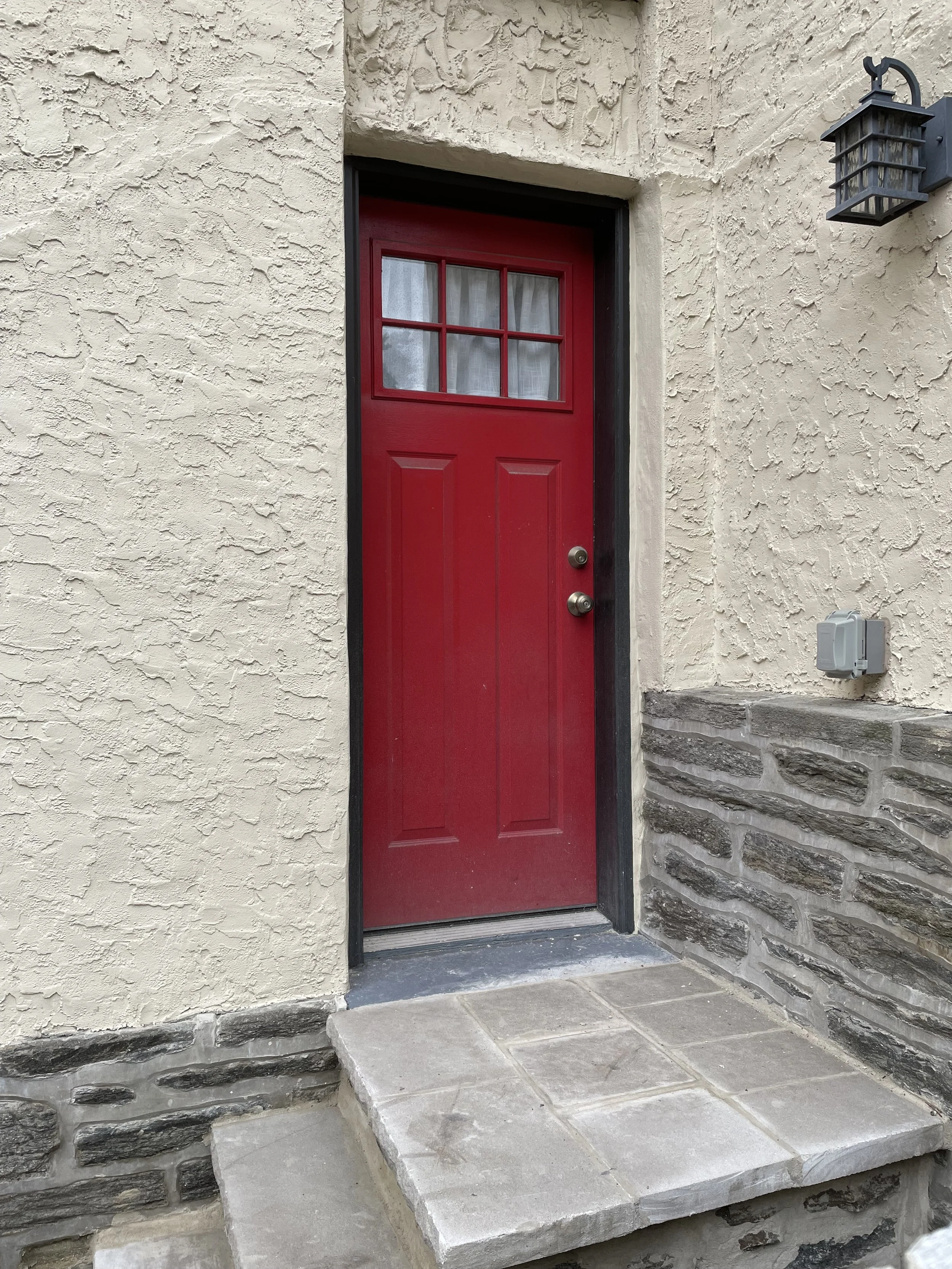
I walked up to the door and examined it. The only marking on it was two letters, ‘e. e.’, burnt into the shiny gloss of the crimson-painted entrance. I tried the handle, and it opened into a vestibule where a large man in a tailored suit was guarding another scarlet door with multiple panes of frosted glass.
“What’s the password?” he asked.
“In just spring,” I replied.
“Enter,” he said, pushing the door open wide for us.
“This place is creepy,” Jane said. “It’s smoky too, but that isn’t the smell of cigarettes. Are you sure you want to have a drink here?”
We looked around. The room was not large but a comfortable size for the twenty-or-so people we saw mingling inside. No one was wearing a mask, so we removed ours as we warily edged up to a couple of stools at the bar. The bar was a U-shape and had an island at its center with liquor bottles ascending it in a rich display of colors and shapes. The wine glasses dripping from the ceiling were partially obscured by the blue-grey haze which clung to the roof like a cloud on a smoggy day. The flip-up exit from the counter was to our left. A couple sat silently near it, their faces pinched from a recent argument.
“Sure. Why not? It’s probably cash-only, but I have plenty.”
“Suit yourself; you always do. How’d you know the password?”
“I assumed the place was associated with e. e. cummings, given the sign on the front entry. So, I gave the beginning line of one of his more famous poems.”
“Clever boy. But that really dates us,” Jane said.
“Well, we aren’t young,” I replied. “I even apparently misplace entire drinking places from time to time.”
We took seats at the dark wooden counter and scanned the crowd. Most of the people were sitting at tables in the room surrounding the bar. It was a mixed group of people by age – a few young people, some middle-aged, a couple of older people.
“What’ll it be?” the bartender asked.
“Two ‘Deaths in the Afternoon,’” I replied.
“What did you order?” Jane asked after the barkeep turned away to mix the drinks.
“It’s the only literary drink I know – Hemingway. It has absinthe and champagne in it. Plus, some syrup, I think.”
“Absinthe?” Jane said, alarmed.
“It’s perfectly safe and tastes like licorice,” I said.
“I detest anise drinks,” Jane said.
“Oh, good. Something different for you. If you don’t like it, order something else, and I’ll drink yours.”
“So generous of you.”
“Absolutely.”
The drinks came, and Jane gingerly tasted the concoction, pronouncing it ‘not bad’ and expressed admiration for the color and the flat, wide coupe glass.
While gazing at the other patrons, I noticed something strange.
“Jane, who does that guy over to our right look like to you?”
“Allen Ginsberg?”
“And sitting next to him?”
“What was his partner’s name?”
I looked up ‘Ginsberg’s partner’ on my phone and said, “Peter Orlovsky.” Eerily, one of the photos on my cell matched the couple at the table. They were both bearded and even had on similar clothes to the photo. Allen had on a sports coat and white shirt, a black overcoat at his side. Peter was wearing a red sports-team jacket over his gray shirt.
“It must be Beat Poet night here at the e. e. Red Door,” I said. “No wonder there is a heavy smell of MJ in the air.”
“A typical Philly scent, though usually outdoors,” Jane said. “Say, isn’t absinthe supposed to give you hallucinations?”
“Naw. That’s an old myth propagated by prohibitionists. Supposedly a drug in wormwood was the problem. But today, if they make absinthe with wormwood, they take that drug out, but only for our reassurance; it never did have much of an impact.”
“We could go over the top,” Jane said. “I have some medicinal candy if you like.”
“You carry it with you?” I asked, shaking my head.
“I forgot to unload my purse.”
“Marijuana usually gives me a depressing hangover,” I said.
“This won’t. It’s a special high.”
“OK. What the hell. Absinthe, MJ, and a time warp. What do I have to lose?”
Jane handed me a couple of green gummies, and I had to ask, “These gummi bears give you a high?”
“Yes, and they are tasty too,” Jane replied.
We chewed the candies and reviewed our surroundings. With a modest passing of time and a few more sips of our cocktails, the decanters behind the bar became shinier and more colorful. The bottle of absinthe oscillated in color between dark green and chartreuse, while the whiskey’s fluctuated from blackish brown to ruby red.
My hankering for a snack became palpable, so I asked the bartender for something to munch on, and he generously provided bowls of mixed spicy crunchies and peanuts. Jane and I could hardly contain ourselves, and the nibbles quickly disappeared.
“What about the others here?” Jane asked. “Any other writers?”
I searched on my phone for images of the Beat Generation while looking around the room.
“OK. Ferlinghetti is in the far corner. The guy nodding off in the back area is Burroughs, and the bartender is Kerouac.
“The bartender is Kerouac?” Jane said. Turning towards the man polishing glasses behind the bar, she said, “I loved On the Road.”
“I’m glad, thanks,” Jack said. “You should try Big Sur; that’s my latest work. The protagonist, like me, is struggling with alcoholism. That’s why I’m bartending; it’s a therapy. I need to cut back on my drinking, but it’s a huge temptation standing behind this counter.”
“I hope it works,” Jane replied. “You’re so well regarded as an author. I’ll get a copy of Big Sur.”
“Thanks. But sometimes I think I might be too famous for my own good,” Jack replied. “Enjoy your evening.”
“He was nice,” I whispered. “Tragically, he only lived to be 47. We must look like old farts to him.”
“I hate this ageism,” Jane said. “Remember last week when we were at the Italian restaurant, and the young waitress was so insulting and unpleasant.”
“We don’t know it was ageism. Maybe that is her natural personality: rude and obnoxious.”
“She was nice to the young people at the table next to ours. Friendly even.”
“Whatever. We’re not going to change it. I can see the headline: ‘Old Farts Protest Ageism: Senior Citizens Occupy All the Benches in Rittenhouse Square.’ People would jeer at us. Remember: we’re in Philly.”
“I suppose,” Jane said, her face sagging at the thought of a demonstration.
“Maybe Allen will be friendly also,” I suggested, emboldened by the weed and cocktail.
“We could try,” Jane said uncertainly.
We approached their table, glasses in hand, and they both looked up at us expectantly.
“Excuse us, but you look like Allen Ginsberg,” I said.
“I am,” Allen said. “And this is Peter Orlovsky.”
“I’m Frank, and this is Jane. Do you mind if we join you?” Allen waved a magnanimous hand, inviting us to sit.
“This is a most interesting bar,” I said.
“It’s our first time here,” Jane added.
“We love it here and come all the time,” Peter said. “Sometimes people give spontaneous poetry readings. Lawrence read one of his recent poems last night.”
“And last week, Burroughs read an excerpt from his latest lyrical novel, Nova Express,” Allen added. “Do either of you write?”
“I dabble a bit but have never been published,” I said.
“Don’t give up,” Peter said. “You can only improve.”
“I read,” Jane said.
“That’s important, especially if you buy books,” Allen said.
“I do,” Jane said, “and I just committed to buying a copy of Big Sur.”
“Jack’s in good form this evening,” Peter said.
“We noticed. But he has chosen a very challenging therapy for his drinking problem,” I said.
“True,” Peter said. “He’s holding up well under the circumstances.”
“I’m inspired to read one of my poems now,” Allen said, reaching into his coat and pulling out a single sheet of paper. Peter clinked his glass with a spoon, and the room immediately hushed in anticipation. It was a brief poem, more of a sing-song rant, against capitalists and our materialistic society, typical Ginsberg, but Jane and I listened with our mouths open in astonishment.
After the reading, Peter asked if we’d met Burroughs, who was sitting alone with his head slumped forward.
“I think he might like some company,” Peter said. So, Jane and I walked over to sit with William S.
“That was a deft way to get rid of us,” Jane said as we crossed the room.
“Maybe they wanted some time alone together. In any case, it was a pleasant pass-off.”
We sat at Burroughs table, and he sluggishly lifted his head and asked, “Are you from Philadelphia?” After we replied in the affirmative, he asked if we knew where he could buy some horse.
“Horse meat?” Jane asked, aghast.
“He means heroin, Jane,” I said.
“Unfortunately, neither of us use that drug, so we wouldn’t know where to find any,” Jane said. “We don’t eat horse meat, either.”
“Pity.”
“I’m afraid I’ve only read Naked Lunch,” I said. “Tell us about your latest novel.”
“It’s a Cosmic Consciousness Love Flesh Dream,” he replied. “Exposing ersatz Immortality sewage of the Garden of Delight with so-called pornographic sections.”
“Sounds delightful,” Jane said, her eyes popping.
“It’s challenging, but it’s meant to be that way. We should all be experimenting with life and understanding the impact of the corporate-political world on our lives,” Burroughs said. “When did they ever not take everything?”
“Yes, we have many issues in this country,” Jane said. “I fear it is getting worse also. You were ahead of your time in your writing and your vision.”
“That’s generous. Unfortunately, I need to get back to my apartment. I wish you both a lovely evening.”
“Thank you. We’d like to listen Ferlinghetti before we go,” I said. “Thanks for your time.”
“Anytime. No time. Only minutes to go,” Burroughs said with a wry smile.
“It was a pleasure meeting you,” Jane said as we rose from our chairs and Burroughs headed for the front door.
“He’s kind of scary, don’t you think?” Jane asked.
“Prescient,” I replied.
Ferlinghetti was in the corner, surrounded by young fans. Unfortunately, there were no available chairs, so Jane and I stood, joining the small admiration society in nodding our heads as Lawrence spoke.
Momentarily, he lifted his head and said, “Welcome, friends. Who might you be?”
We introduced ourselves, and a couple of generous students offered their chairs, embarrassing us, but we thanked them and sat down as it would have been impolite to do otherwise.
“Such a contrast to that waitress last week,” Jane whispered in my ear, and I dipped my head quickly in agreement.
“We were discussing Ezra Pound, who, as you know, came into disrepute after he publicly supported the Italian Fascists in World War II,” Lawrence said. “However misguided that was, I believe his literary work, particularly The Cantos, was extraordinary and is essential reading for aspiring poets.”
“It’s not an easy work,” I said.
“No. But it’s an epic and has many allusions to Greek myths and the like,” Lawrence said. “Pound was a master of allusion, and this is what makes The Cantos a great work of poetry. Of course, you may also want to read my latest work, Routines. It’s 13 short improvisable plays about understanding Existence.”
“OK. I’ll give them a try,” I said.
“Good,” Lawrence said. “Read, write, publish. That’s my advice to all of you, and now I will bid you goodnight.”
We all stood, and he shook hands with each of us before disappearing through a red curtain labeled ‘Employees Only’ at the back of the bar.
The students headed to the bar for another round, leaving us sitting with our drinks at two push-together tables.
“Do you get the feeling we are getting shuttled along by the writers?” Jane asked.
“Everyone is busy,” I said. “And they were all cordial.”
“I’m dizzy,” Jane said abruptly.
“OK. I’m not sure I could make it through another round either,” I said. “But it has been fascinating. It reminds me of the time I was at the City Tavern and chatted with Ben Franklin.”
I paid for our drinks at the bar, and we wobbled home, the sun glaring at us for the duration of our journey.
#
The following week after another film at the same theatre, we found our favorite post-movie bar on Chestnut Street, where it had always been.
“I must have gotten the address wrong last week,” I said. “Though I was sure we were at the right building.”
“Nevermind,” Jane said. “We found it this time.”
After we finished our glasses of white wine, Jane suggested we drop by the Red Door on the way home. We found the entrance. The paint had faded to a dark pink and was pealing. Where the ‘e. e.’ had been, there was a deep, violent gash in the wood. I pounded heavily on the door, but there was no response.